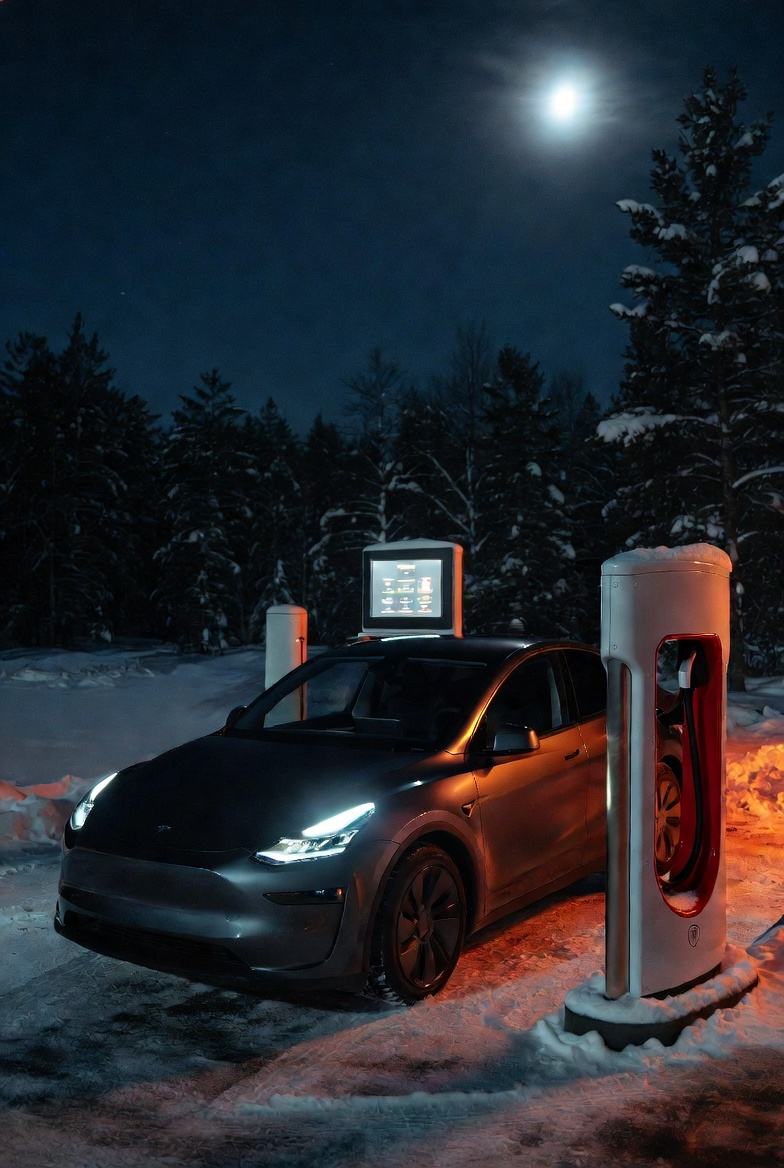
It’s December 24, 2025 here. Five years ago, in late 2020, I took delivery of my Tesla Model Y—and it’s been my daily driver ever since. (Quick note: I owned a 2018 Chevy Bolt for three years before this, which gave me early EV experience including the big battery recall, but all the data and deep dive here is purely from the Model Y’s 215,000 km.)
That’s a ton of commuting, road trips, and real-world Canadian driving. Numbers come straight from the Tesla app, TeslaFi, and my own tracking—no cherry-picking, no fanboy spin. EVs aren’t perfect (I’ve had my share of headaches), but the data shows why I still love it.
The Gripes Up Front
Early 2020-build Model Ys had some teething problems, all cars have their unique sets of issues:
- Four heat pump failures (known issue in cold climates) – this one drove me the most crazy, it was only repairable by the dealer, the parts were expensive and when it happened the car was DOA.
- Premature brake line and component corrosion from road salt, Tesla didn’t bother to coat the lines in anything, and they routed them above the pack, and the drive units – so repairing them is INCREDIBLY expensive.
- The paint is the worst paint I have seen on a car, and that’s not a surprise to anyone.
- Failed headlamps requiring a retrofit, Tesla discontinued the reflector lights, the only option was to retrofit to Matrix LEDs – at an incredible cost.
- Low-voltage (12V) battery replacement – Expected frankly.
- Worn-out charge port needing full replacement
All cars have issues, but some of these were frustrating and costly when out of warranty.
Battery Degradation: Nearly 20% After 215,000 km
TeslaFi puts my degradation at 18.97%—right in line with the fleet average for similar mileage and age. Nothing abnormal, but it still means my original ~500 km rated range is now realistically around 410-425 km in ideal conditions.
Degradation is real, gradual, and irreversible.

Overall Efficiency and Regen Magic
Lifetime average efficiency: 69.72% (relative to ideal/mild conditions). This is an important statistic, because all automakers seem to have overly ambitious numbers. Tesla claims 150wh/km in the software – it’s REALLY difficult to get that – I mean – nearly impossible
Energy used by the car: 54,394 kWh. Charged into the battery: 47,845 kWh.
That ~6,549 kWh difference is energy I got back from regenerative braking—basically free miles in traffic and on hills. This is noticeable, my drive to work is mostly downhill, and I use 30% less energy driving to work than I do driving home. That’s $1375 savings in just regen, but – I am getting ahead of myself.
The Highs: Charging Costs and Huge Gas Savings
Total electricity cost for 215,000 km: $9,207.~
At average fuel prices over the period – that’s 2.91L/100 km
Breakdown:
- Home and Level 2 (mostly workplace/public): 2,151 sessions, 39,604 kWh
- Home charging: Cost $3,233.50
- Free or cheap public/work: Saved $2,875.46
- Supercharging: 330 sessions, 9,100 kWh, $3,655.25 – This works out to only be $93 total cheper than gasoline – The bottom line – Public charging is the same price as gasoline.
- Non-Tesla CCS: 28 sessions, 440 kWh, $93.51
Average: ~4.3 cents per km.

Maintenance Reality Check: More Than the Hype – And More Than I Expected
No oil changes is nice, and regen helps brakes in theory—but Canadian road salt, instant torque, constant plugging/unplugging, and early-build quirks add up.
Here are my major out-of-pocket repairs over 215,000 km:
- Tires: 4 full sets × $1,200 each = $4,800
- Brake pads: 3 sets
- Rotors: 2 sets
- Caliper replacement: $700
- HVAC/heat pump repairs (two fixes after warranty): $4,000
- Headlamp retrofit (both sides failed): $1,200
- Charge port replacement (worn out from daily use): $800
- Low-voltage 12V battery replacement: $150
That’s over $11,650 in known big-ticket items alone (not counting labour for smaller stuff or the brake pad/rotor sets). EVs still skip a lot of traditional service, but real-world costs—especially corrosion, torque wear, and Tesla-specific parts—pile up faster than the marketing suggests. Did I have more failures than average? Perhaps. The tires I can live with, the HVAC repairs – I wasn’t happy with.
Temperature: Massive Impact, Even With a Heat Pump
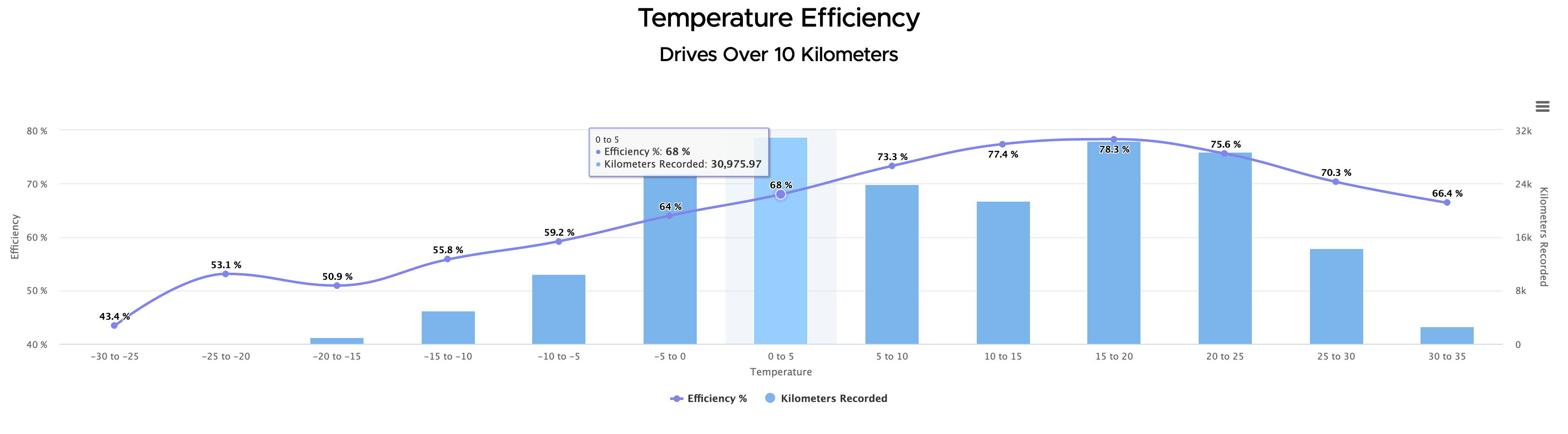
Tesla’s heat pump is clever—it pulls waste heat from the motors/battery/outside and uses smart tricks like the octovalve—but it doesn’t have a traditional resistive fallback heater. Below about -10°C, there’s less ambient heat to scavenge, efficiency drops sharply (my data shows it falling off a cliff), and in extreme cold it struggles to keep up, sometimes leading to failures or poor performance. That’s been a well-documented pain point for early heat-pump Teslas in harsh winters.
My real-world numbers:
- 43% efficiency at −25°C
- 78.3% at 20°C (peak)
- 66% at 35°C (AC drag in summer)
Winter range can easily drop 40%+.
Speed Penalty
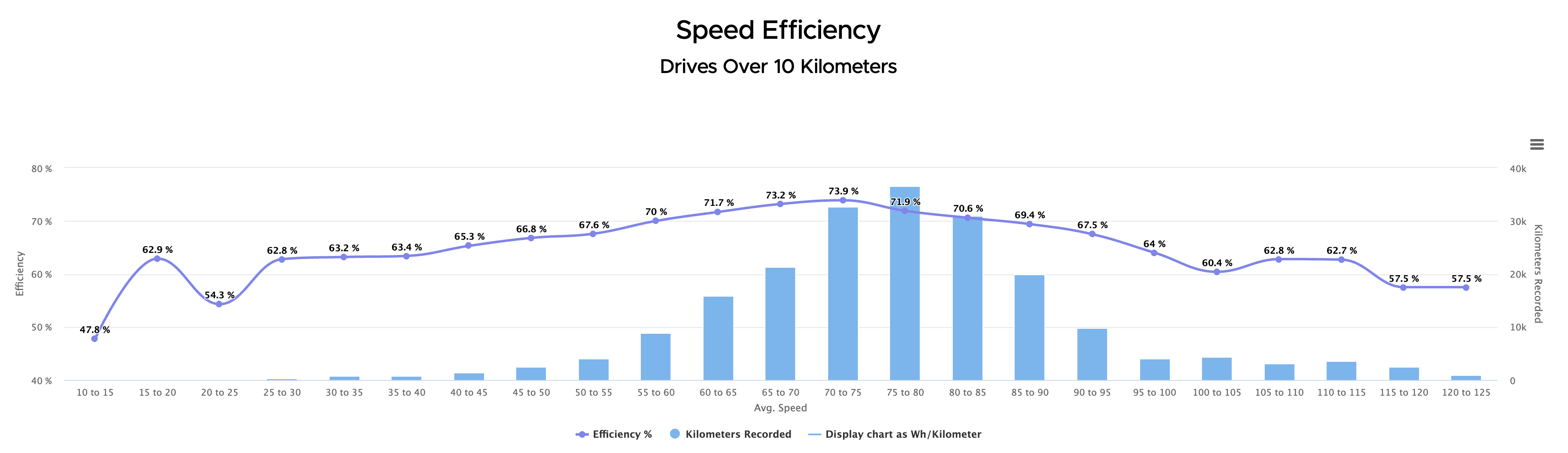
- 73% efficiency at 70-75 km/h
- 57% at 120 km/h
Highway driving hurts—standard aero physics. This stuff is pretty obvious, but I figured it is a data point worth sharing.
The Crucial Range Advice I Give Everyone Now
Here’s the hard-earned lesson: When buying an EV, make sure about 50% of the rated EPA range comfortably covers 90% of your normal driving.
Why? Stack the real-world hits:
- ~20% degradation after high mileage
- 30-50% winter efficiency loss
- You rarely use 0-100% (most stay 20-80% daily)
- Highway speeds, headwinds, heat/AC, cargo
A “500 km” car can realistically give you only 220-250 km of stress-free winter range.
Buy more range than you think you need. Future-you will thank you.
The Money Breakdown: 60-Month Ownership Savings
Let’s put real dollars to it over the full 60 months (5 years) and 215,000 km.
My Model Y energy cost: $9,207 My major repairs/maintenance: ~$11,650 Total operating cost: ~$20,857 → $347 per month
Now compare to similar-class midsize crossovers (2020-2021 Canadian retail prices, real-world mixed driving):
- Gas equivalent – Toyota RAV4 AWD (10 L/100km real-world average)
- Fuel cost at $1.47/L average: $31,605 Typical maintenance/oil changes/brakes over 215,000 km: ~$6,000–8,000Total operating: ~$38,000–40,000 → $633–667 per month
- Hybrid equivalent – Toyota RAV4 Hybrid AWD (real-world ~6.5–7 L/100km)
- Fuel cost: ~$20,500–22,000 Maintenance slightly lower than pure gas: ~$5,000–6,000Total operating: ~$25,500–28,000 → $425–467 per month
Even after my higher-than-expected repair bills, the Model Y still comes out ahead—especially against pure gas, and even against a strong hybrid.
Bottom Line: Does Electric Still Make Sense in 2025?
For me—yes, without question. 215,000 km of data shows energy and cost savings, addictive
performance, silent cabin, OTA improvements, and a charging network that just works.
The inconvenience of charging – is rare. If I go back and look at my charging stats, my average supercharging session was 19 minutes, yes that still works out to nearly 4 days, but most of those I was doing other things, if you compare to gas over the same time – I would have lost about 2 days of my life just filling up with gas. Anyone can justify why supercharging is “ok” – I agree it’s less than ideal – but you learn to get things done while charging, it’s a bit of a mindset change. If I was driving to Florida from Toronto – I wouldn’t take the EV. For me the max road trip distance is about 1000KM – beyond that the charging “slack” time just starts to add up. Time savings vs the pump? If I had exclusively charged at home and never supercharged — that’s 2 days back.
The downsides are real: degradation, cold-weather penalties, corrosion repairs, tire costs, headlamp/HVAC/charge-port/12V bills. If you live in extreme cold, do mostly high-speed long hauls, and don’t have home charging—pure EV isn’t for you. There will always be a place in this worth for gas powered stuff – at least for now.
But here’s the thing: I love driving this car. Experiencing the latest technological advancements from the Tesla team, the constant software updates, even the occasional quirks—they make it feel alive. For me, living on the bleeding edge of tech every single day isn’t a bug; it’s a feature.
I’m all in. No plans to go back—the savings are real, and the drive is unbeatable.
 cantechit - Technology and IT BLOG