CiscoLive! Techtorials – Worth it? #CLUS 2017

Are Techtorial Sessions Worth It ?

In a word?   YES.

Now to explain why….

This year I flew out Saturday, and was here on Sunday, in order to attend a techtorial.     I chose Immersive Journey Into IPV6.  Yes, it’s true, I am not a superpower when it comes to IPV6, I know enough to do what I need, and what my clients need, but I am lacking.

Where am I lacking?  Think about IPV4, ARP, DHCP, DNS, all those protocols and how they talk to each other, how they work at the bit level.   I know that stuff pretty cold, but IPV6 the light bulb never went on, for me I just didn’t feel comfortable, I didn’t feel like I knew it cold.

Well, that changed today, after an entire day in the room with amazing speakers, Denise Fishburne, Scott Hogg, Ed Horley, Tim Martin and Jim Bailey.   Feel free to check out their credentials, but Scott literally wrote the book on IPV6 Security as one example.     Denise “Fish” Fishburne is without question the premiere troubleshooter (See my previous blogs).

Our session went down like this..

Screen Shot 2017-06-25 at 3.21.43 PM.png

This was a SERIOUS content download, we went into a ton of detail in each section.  Fish talked about how she learned IPV6 from the packet and backwards into the RFC,  Scott talked about IPV6 hacking and vulnerabilities and how to protect yourself from common attacks.   The design section went into IPv6 address design and even had a enterprise design practical example.  Ed went into AMAZING detail about host operating IPV6 support, what works, what doesn’t and tips for deployment.   This section I really appreciated, there are so many nuances.

Why is the money worth it?

Quite simple – bang for your buck.   Sure, one techtorial is about 30%  more on top of the cost of your entire full conference pass, but in previous years I noticed I was taking out so much time for World of Solutions, DevNET and other sessions, I couldn’t FOCUS on topics I wanted a deep dive on.   I also missed sessions I wanted.  With the Sunday session techtorial, I could get in the room, listen from multiple amazing speakers on a great topic and there is nothing else I am missing.  I could FOCUS.

The benefit of going all day on this topic is, each section threads into each section and you get continuity in learning.   Don’t forget, this is a Sunday, that means there is also less of a chance that your regular job duties will interrupt you.

If you want to get the most out of your CiscoLive! trip, you want to be able to see as much as possible. Focus on the Sunday on the topic you wanted that deep dive on, it allows you to learn better. This will free up time later in the event to hit the World of Solutions, try new things in DevNet, and hit up even more of the smaller sessions.

Keep in mind, you can pay for techtorial sessions with Cisco Learning Credits (CLC) so make sure when you purchase Cisco Hardware and Software to make sure your partner and Cisco rep are working to get you those CLC’s.

disclaimer:  I won this techtorial last year in a social media contest, and redeemed that free credit this year.  I did not pay out of pocket to attend this session.

Cisco Live! Returns to Hot Breakfast!

Last year I wrote this blog about the breakfast offerings at Cisco Live!, outlining the importance of a good breakfast on learning comprehension.   I made sure that this information received wide distribution, and many of you helped with your retweets to the team @CiscoLive, and as a result it did become something considered this year.

I have been advised by the Cisco Live team that hot breakfast sandwiches have been added to the menu for Monday through Thursday!    This is amazing news.    I have to thank in particular Kathleen Mudge @KathleenMudge  for helping spread the word at Cisco Live offices.

“Food is like a pharmaceutical compound that affects the brain,” – ULCA Professor of Neurosurgery and Physiological Science Fernando Gómez-Pinilla.

Short term memory and auditory attention are higher when a breakfast offered with protein as opposed to refined carbohydrates is offered, no more sugar crash, and power through your day.

For me personally, this is important, as I have recently embarked on a low-carb Ketogenic lifestyle.  More options give us better ability to learn and interact.

This is a great win for all delegates, and for the social media community as a whole.


NSX – The Network Redefined

Looking Forward

The network has been a long haul.   Wow, what a long way we have come from a long time ago, to hubs, to switching and now to networks being virtualized, on hardware, on software and sometimes even on the occasional Raspberry Pi device.

There are so many terms out there, and nobody agrees on what the definition of “SD” anything is.   If we go by Wikipedia, they claim ”

Software-defined networking (SDN) is an approach to computer networking that allows network administrators to programmatically initialize, control, change, and manage network behavior dynamically via open interfaces[1] and abstraction of lower-level functionality.”

That is a little general, isn’t it?   I mean how does that concept help a business actually deliver on value?  How do I get from “SDN” to business value, without spending millions of dollars and hiring people to internally write “stuff”.

Everyone tried to create something, and as things normally go, everyone said “let’s use this open protocol” – not realizing that the open protocol did about 60% of what we needed in the real world, didn’t have an interface because it is a protocol and we need a gaggle of PHD’s to deploy it.

If you are a developer you are probably reading this thinking – “It is not that hard” – but for some of us, especially traditional network types or managers, it really is that hard, and what about the <1000 user crowd.

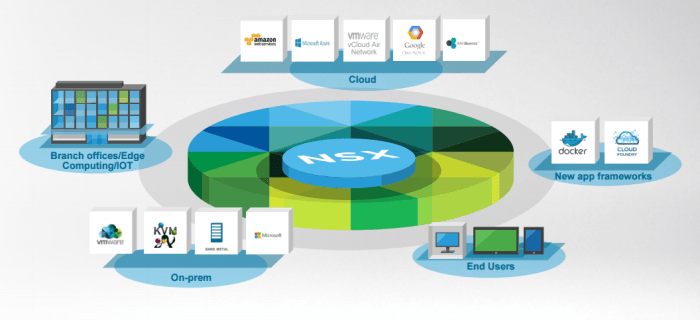
VMWare does for the network what it did for servers

This is that kind of thing, VMWare is changing the game, again.
2017-06-12 14_06_20-NFD15-VMware NSX-vFINAL.pdf

I have to admit, I was not a believer.  I was truly the person that sat here and thought “If I want to virtualize my network I want to do it in silicon”.   CPU power has reached a point where that argument does not hold water anymore, and we can engineer our way around that anyway, it is a moot point.

Virtualizing Network Hardware Is Different

Here is the problem with something like a pure Cisco ACI, or virtualized in the hardware.   The entire point of network virtualization is that the network shouldn’t matter.   If I want to create a truly elastic infrastructure, then my environment must not care what the transport is underneath.

I am not suggesting the wild west, on the contrary, you still need to monitor, manage and engineer the underlying network to attain the performance you want, but if my intention is to create a Hybrid strategy into cloud services like Azure, AWS, TATA or Long View ODI, I shouldn’t much care.   I want to put the workload where I want, when I want, with the security definitions I need, and I don’t want to use 27 different tools to achieve that.

Applications Are The Focus

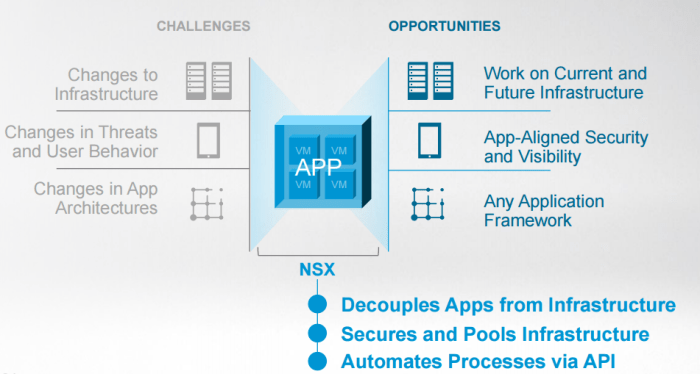
Everyone is talking this way, Cisco is talking ACI – Application Centric Infrastructure and VMWare is talking NSX, but the concepts are the same.   You need the security of your apps and data but you need to deal with changes in threats and user behavior.   You need analytics and security.
2017-06-12 14_02_49-NFD15-VMware NSX-vFINAL.pdf

The APP itself needs to be decoupled from the underlying infrastructure to make things elastic, but to attain the true elasticity, you need an automation platform that does a few things

  1. Delivers on IT and business process
  2. Automates to remove mistakes
  3. Does not require significant programming knowledge
2017-06-12 14_07_06-NFD15-VMware NSX-vFINAL.pdf

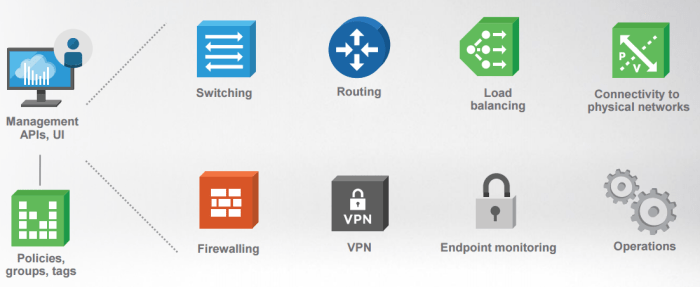
Ideally you need to have all of this in a single pane of glass to make it easy to manage, otherwise, cross management integrations are going to cause you a ton of headaches.  When people say “service chaining” I start to get a migraine.  Not to say you cannot to that, you can, and they integrate with a huge ecosystem of partners, but I should not have to pick a management platform and then everything else is a partner product.

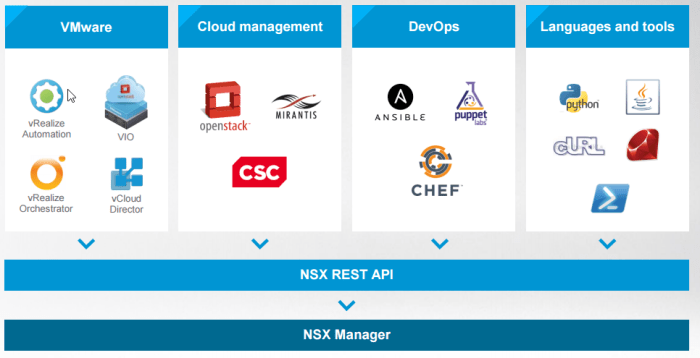
You can go wild if you want
2017-06-12 14_10_47-NFD15-VMware NSX-vFINAL.pdf

I keep complaining about going “fully open protocol” – but the good ews is, if you want you can go full open protocols, full automation and full custom with NSX if that is what you want.  They have the automation tools to get you there.  So if you are the developer type, and I am not, feel free to go and get your python on and chef yourself some puppet stacks – I will be over here wishing I honestly understood all that stuff.

Give me the veggies

Here is the story on what you need to know, we will break it down into a few bite sized chunks.

Architecture
2017-06-12 14_12_56-NFD15-VMware NSX-vFINAL.pdf

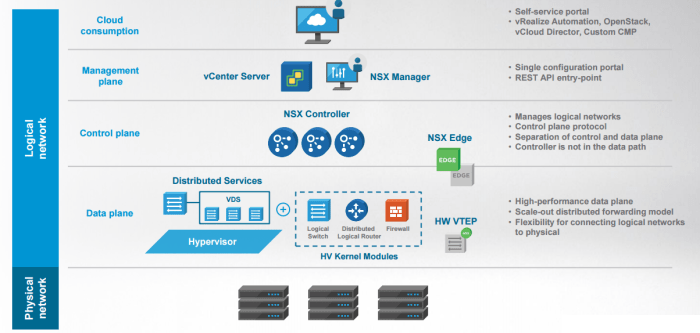
vCenter is still here

So the big things you need to knows.  vCenter is still very much a part of how you live, and NSX Manager plugs into vCentre to give you all the management you know and love.  The good news is, they are not reinventing the world here, so if you are already a VCP or VMWare savvy person you should feel right at home.

NSX Controller

The NSX Controller manages the world of NSX, but is configured by the NSX manager plane.  All of your logical networks, and control is done here.  This isn’t in the data path, it is basically orchestrating the config download to all of the componants.  The distributed logical router (fancy name for a virtual router) and the switching endpoints.  You don’t really deal with this day to day

Data Plane

This is your hypervisor, and you don’t really change anything here – your connectivity is in place, and the hypervisor knows from the controller which domain each VM is in, and if it needs to be transported between sites and to whom it can talk to.   This is where your logical switch, distributed logical router and firewall processes actually live.

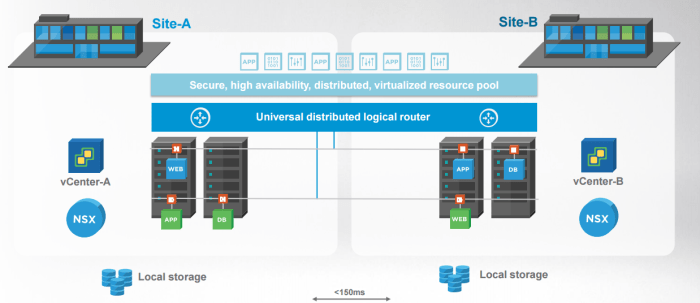
Multi-Site Capabilities

This is where I think NSX really shines, not just in the ability to segment, but to take that segmentation and make it elastic across locations.  Pick up and move a VM across data centers, and IP addresses do not change, and security constructs remain intact.   Doing maintenance in a DC and need a full shut down?  No problem, move your workloads and shut it down.   Distribute your apps using the built-in load balancer across the network.
2017-06-12 14_08_57-NFD15-VMware NSX-vFINAL.pdf

The key here is that this works brownfield, no need to lift and shift all of your apps into a new network design to make it work, and no application has to change IP addresses to get this DR functionality.   Extend across geographical boundaries, keep your security posture in check.

When moving workloads there is no need to lose your security policies because you are moving workloads around, and you do not pay for NSX DR licenses for active standby, only for active active.

2017-06-12 14_51_22-NFD15-VMware NSX-vFINAL.pdf - Adobe Reader

The multi-site capabilities alone are a reason to deploy NSX – and many customers do, even if they are not micro-segmenting their network today, the mobility options alone are worth the price of admission.


Micro-Segmentation

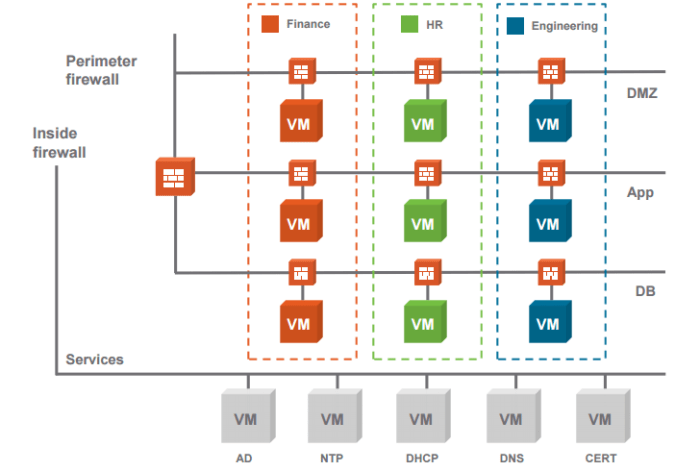
What an industry word, but the bottom line is, we need to segment services from services at the service level – not at the subnet level.

This is a stateful firewall, with full chaining out to IPS/IDS possible, 5 tuple configured.

This is not just ACL, it is a full ALG, so it will take data and control / ephemeral ports and groups them so you do not end up with a giant mess in your rules as well.
2017-06-12 14_33_58-NFD15-VMware NSX-vFINAL.pdf

A bit of an eye chart, but the idea is that each VM can not be its own perimeter, and policies are created once and then grouped so mistakes against policies are reduced.  Threats have a hard time spreading when things are locked down like this.

2017-06-12 14_46_53-VMWare Distributed Firewall - Google Search

The firewall manager is very intuitive, basic rules to set everything up, but the challenge is how to setup the rules right?

Policy Creation Costs Reduced with ARM

The cost of deploying new policies is significant in many organizations – some spent 10-50x the cost of their firewalls just to come up with the policies to segment subnets, only to end up with giant holes in their firewall rule set.

This is what makes NSX something you can actually deploy, you really need a tool like this in order to put something like NSX in production.  Nobody understands application data flows (ok some people do) but there are always mistakes made when segementing your network.

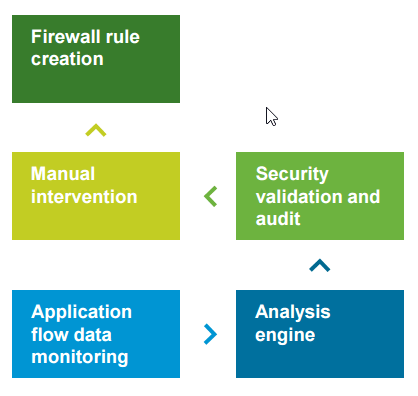
The good news here is something called ARM – Application Rule Manager
2017-06-12 14_37_23-NFD15-VMware NSX-vFINAL.pdf

Everyone has done this, you set up your rules, set your allow all, watch your syslog for events, then go to deny, monitor your deny logs, anger a few users as things break, fix your firewall logs.   There has to be a better way, and there is with ARM.

You can monitor application flows in real time, and then create rule sets from those monitored data flows.   ARM has been segregated from normal flow monitoring, so there is no impact to production traffic, and they do limit the number of VM’s you can run ARM on at the same time.   You are not supposed to run this all the time.
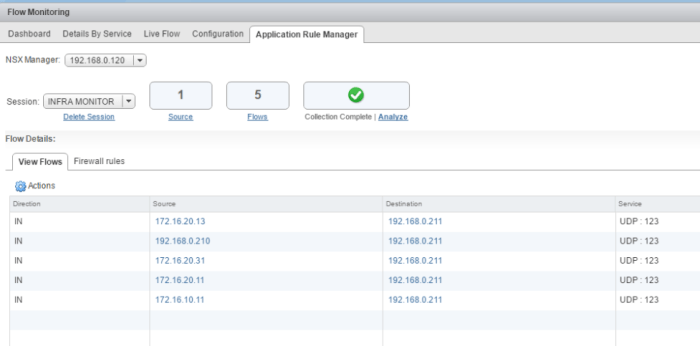
2017-06-12 14_44_50-arm_ms_pic3.png (1639×997)

Remember this is an ALG, so it understands ephemeral ports, and protocols like FTP so if you allow FTP, then FTP will work.  Windows RPC is just Windows RPC.    All the rules can be cached and setup, without implementation and then you can get your security person to review all of them, approve and then move forward.

Once things are setup, now you can monitor the actual flows, and show packets and bytes so you can see your rules up and working.

2017-06-12 14_46_40-VMWare Distributed Firewall - Google Search


Automate with vRealize

The automation within vRealize has been around for some time, but now with the ability to deploy automated NSX rules and pre-defined architectures will provide large organizations with the power to deploy new applications, or even container applications very quickly.   The good news is, the interface here is very easy to understand and with a “canvas” style approach you can build out your applications and services in a graphical manner and see relationships with attached policies.

I could honestly go on for while about just automation, but here is a taste of the interface, expect more in another article.

2017-06-12 14_58_02-nsx vrealize automation - Google Search


Disclaimer for this article

This article was written a few months after I attended Networking Field Day 15, as in my previous disclaimer we normally receive things like bags and hats and some of my expenses are covered by the event.    However, after this presentation I was offered some free training vouchers from VMWare for NSX training and certification – they were offered months before I even wrote this article, and I have not consumed them as of this writing but I plan to.   I am disclosing this because of the sheer value of those vouchers exceeds the normal “here’s a free hat” offer.    I would like to thank VMware for their generosity, and I plan to use them to further my personal education on NSX.
SAY MY NAME – Cisco Live 2017

Sources are telling me that Bryan Cranston will be the guest celebrity keynote at Cisco Live 2017 – #CLUS

Bryan_Cranston_a_l_0

Bryan Cranston won the Primetime Emmy Award for Outstanding Lead Actor four times, three in a row.  Once he was a producer he also won Outstanding Drama Series.   Growing up in California, acting was natural to Bryan.  During his early career he did it the hard way, commercials, and small productions until landing larger roles in Saving Private Ryan, Seinfeld, King of Queens and then of course Malcolm in the Middle and Breaking Bad.   Now a six episode half-hour series called “The Dangerous Book for Boys” a new comedy series from Bryan Cranston has been picked up by Amazon.

Last year we were thrilled to listen to Kevin Spacey talk about how technology had revolutionized the TV and Movie industry with Netflix now becoming a content creator, how he traveled through space and time creating an amazing career.   Now with 3D immersion the game will change again, and if I had to guess Kevin Spacey will be at the forefront.

This year, Bryan Cranston will take to the stage and talk about….  We have no idea, but I know this, it is sure to be an amazing talk.   I personally hope to hear about his life, and career along with his thoughts about disruptive technology in the business.


Ford Finally Delivers CarPlay to 2016 Customers – almost a year late

It has finally been posted to owner.ford.com

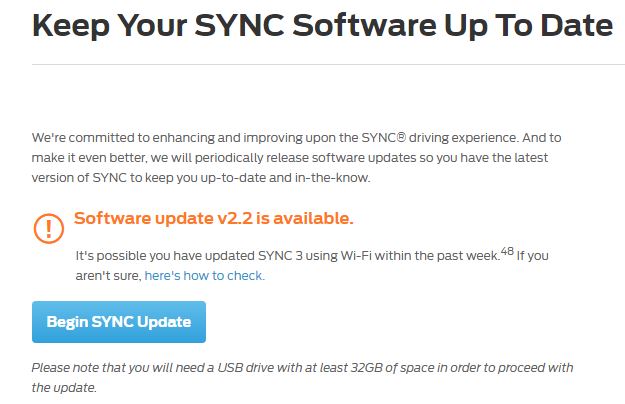
After almost a one year delay (It was promised Summer 2016 to customers) Ford has finally provided the Sync 2.2 update on their website and officially offered it to customers.

Keep in mind 2017 owners, with the same devices all had 2.2 from the factory in some areas in July of 2016,  and many other owners who were willing to install software from the internet, had it as early as December.  So why the 6-8 month lag for people who were promised this the day they purchased their vehicles they will never know.

Many customers have said this is their last Ford,  many people have even sold their Ford vehicles over this – yes that sounds crazy.

Justin’s opinion…

What bothers me the most, is that Ford has been touting themselves as a technology company, being the first car manufacturer to ever present at CES, to the first with major technology like Sync.     If your intention is to be the “Apple” of the car industry, it seems to me that it started out well, but they are ending up with promises with limited delivery.   Perhaps they are finding out what being a technology company is all about, it isn’t as easy as they thought.

Sync 2 running on Windows was an absolute and abysmal failure with tons of performance related problem, app issues and integration problems for third parties.   Giving up on Windows and going to QNX fixed the performance problems, but now on a more realtime embedded type operating system, Ford is struggling to keep up with feature releases like this.

Either Ford figures out how to take their place back a the top of the technological automaker spot in the industry – or someone will surpass them, and it might very well be the likes of Apple, Google or even Tesla.


now22


Ford still not delivering CarPlay to 2016 vehicles

It is funny when you write a blog post – and it becomes strangely popular.   This is a tech blog, but I toss in some occasional rants, or rally type stuff about thing going on around me.

I’m going to help you FIX this if you own at least a Ford F-Series….

To give you an idea of what I am talking about, and why it confuses me so…  In 2017 here are the top posts on my site.  As of 4/22/2017 when I wrote this.

Ford Promises CarPlay – Fails to Deliver – 4967 unique views

Cisco Spark Board – Innovation In Collaboration – 2108 Views

stats

I’m horrible at web sites, and at SEO, but I guess sometimes the SEO bit starts to work properly, because my Ford Promises CarPlay blog is by far the most popular thing around here.    With that in mind, everyone is finding their way here because of the issue, so let me try and help out.

First – go to your dealer and try and get the upgrade, that is the legal, non warranty voiding method, if you do not want to wait anymore – proceed with the understanding this is at your own risk.

There are 2 scenarios you are in


You own a 2016 Ford with Sync 3 Version 2 – but CarPlay does not work

The good news is, this is very easy to fix.   The issue was that when these vheicles shipped, Ford was not shipping a “CarPlay” compatible USB Hub, the Sync unit has 1 USB output which goes down to a hub in the dash that you plug into.

Once you update to the correct USB Hub – CarPlay will just work for you.  So what do you need to do?

Goto Ford, and get the correct hub, I don’t know the part number for every car, if you look online the various car forums can probably help you – OR – you can simply go and ask for a replacement USB hub for a 2017 model of your car.

For the 2016 Ford F-150 here is the model number you need.    The parts guy might give you a hard time, tell him it’s for a 2017 Ford F-150 Lariat, tell him you don’t have a VIN, and that’s the part number, if he says “IF this is the wrong part it is your fault” — just say “Yep i’m fine with it”  it shouldn’t cost you more than $100

GJ7Z-19A387-B (WHITE BACKLIGHTING)
HC3Z-19A387-B (BLUE BACKLIGHTING)

Here is a video showing how to do it…  Thanks to that user for posting.


You own a 2016 Ford with Sync 3 – and your version is not 2.0 or higher

This is where things get a little more complicated.     First you need to do the step above for those who have 2.0 or higher, so stop now, and go order that part, when you are done, come back.

Ford seems to not want to send out the upgrade from 1.0 to 2.0 – that is the problem here – yes the issue is some kind of software issue, which we don’t know why because the rest of us who are willing to play with our vehicles, have been running CarPlay for — 4 months at this point.

Now that you have the new hub, you need to search online for the specific Sync 3 2.0 upgrade package, you put it on a USB key, and plug it in, and the upgrade procedure starts.    I am not providing links to that software, that would probably break all kinds of laws – if you are willing to take the chance, I am sure you can find it.   WARNING:  It is very easy to use the WRONG upgrade file, ensure you are using the correct file, for NAV vs NON-NAV models (no you can’t upgrade to free NAV) .

Here is a video of someone doing it on a Ford Focus RS

Cisco Live – 2017 – CAE Headliner and Inside Scoop

I have received the inside scoop on #CLUS – Cisco Live 2017…   Here is the things you want to know.   First CLICK HERE to get details on the event.

CAE HEADLINER

Bruno Mars

brunomars

What more is there to say, five Grammy awards, six number one singles, and multiple songs on the top 10 at the same time.    Bottom line you can expect a serious line up of amazing entertainment!

For details on the CAE, click HERE.

Social Media Contests

There are a ton of contests this year, best tweet, best photo, most engagement, the bottom line is, share and share alike.   Get social, even if you are not at the event, there are Amazon Gift Cards up for grabs.

All New Floor Plan

This year, Cisco Live is mixing it up, with previous years the DevNET zone, Cisco Store and World of Solutions were spread out across a pretty great distance – this year, no more.  An all new layout integrates the DevNET zone into the World of Solutions floor and an all new Industries and IoT Village.

Selected as NFD 15 Delegate

Last year I was pleased to be selected for Networking Field Day 12 in Silicon Valley.   This event was amazing, and I was able to learn and publish tons of great information from some big companies in Silicon Valley.   Everyone from the big guys like Intel, to smaller startups like Teridion, Kentik and Nyansa.    Even a few presentations that made my brain bleed like those from Brocade.

For me the Networking Field Day events are about collaborating with amazing people, it is about working with some of the best people in the industry.  Learning and interacting with the up and coming tech companies and keeping myself ahead of the technology curve.

For me the huge take away from that event was that SD-Networking is not coming, it is here.   Innovations in microsegmentation from the likes of Illumio.  New ways of thinking about networks and applications from companies like ThousandEyes.

What is cool about Networking Field Day is – while I have been selected as a delegate, everyone can participate, the event is as interactive (or more so) than Cisco Live, you can virtually attend as a virtual or community contributor.   Every event is live streamed, you can send in your questions on twitter, and I promise you, someone WILL ask it.

So head over HERE to check out who and what will be happening at Networking Field Day 15, April 6-7.  As of this writing we have ipInfusion and TelioIP presenting but more will be announced soon.

Live video links will be posted on the Networking Field Day page, and my page, and on twitter during the event, so grab that extra monitor and a pair of headphones and join in on the action – besides, it’s FREE!

Vault7 Lessons – Zero Trust

Zero Day Exploits,  0-Day,   custom malware, tailored malware,  infected humans.   All things we have no way to protect against using signatures.

Signatures have been our life in security for a long time.  Virus update packs, signature updates.   Vendors like Cisco even helped build complex and expensive security reach task forces like TALOS – amassing over 250+ researchers who look for new malware, take it apart and then build protection against it – in almost real time.   This means we are reasonably well protected from things we know about

I still wash my hands

What?   That is because I don’t trust licking my palms when they are not clean.  If I trusted that I had all of the immunizations and that new “flu” vaccine gave me everything I needed – I could run around never washing my hands, but we all know that the flu vaccine only covers last years and SOME of what is coming.

Then why are firewall IPS signatures, and virus signatures enough for many corporations and end users?

Trust No-One

Sorry boss, but there’s only two men I trust. One of them’s me. The other’s not you.”  – Cameron Poe (Character in Con-Air played by Nicholas Cage)

Anyone that knows me, knows I tend to use movie quotes a lot.   Customers look at me funny when I say something similar.   Trust nobody,  don’t even trust me.   Every person, machine or connected object could become ‘Weaponized’.    The minute you start trusting you are opening the door.   We all lock our front doors, but we do not lock our interior doors,  but if you found out someone else MIGHT be running around with a universal set of keys – you might start locking that bedroom, and maybe do it with a different kind of lock so that the person with the universal key has a harder time.  So why do we rely on traditional firewalls so much and then leave our interior networks wide open?

Vault7 – Wikileaks

The latest release from the team at Wikileaks proves the need for Zero-Trust models.    If the CIA was accessing vulnerabilities that were not publicly known,  that means hackers and bad actors in your networks could be using them as well.    The CIA is very well funded, and this release provides a glimse into how well organized and funded they are.    I want to be clear, this isn’t a negative comment towards the CIA, in actual fact I would have been surprised if they were NOT doing everything they could to protect the country.

This is a very good glimpse into the inside of an organized cyber activity program, and what we need to learn from this is – zero-trust or bust.

There is a small silver lining to such a leak – this view into an organized and well funded cyber program and the tools, tactics, and methods they used will help organizations learn about how to protect themselves.   Not that we didn’t know much of this before, but this will help harden and strengthen networks as a whole.    A wake up call, a chance to learn and a chance to realize that when they are well funded (which organized crime organizations are) they can mount cyber campaigns of significant complexity and capability.

Bad Actors Are Everywhere

Do not think for a second others around the globe are not doing the exact same thing,  foreign governments and organized crime are very much involved in these types of activities as well – it is just that in this case Wikileaks is calling out the CIA because that is the leak data they received.    We can learn from this, we can become a more security information technology industry

Zero Trust Design

A new world of security products has started to emerge in recent times, and new design philosophies are being suggested, but it does require a paradigm shift in thinking, and the realization that security will start to impact users day to day lives a bit.    No different than when seatbelts became mandatory.

Encryption In The Way

On a recent podcast (Cisco Champion Radio) Peter Jones from the Cisco Catalyst team tossed out this quote (sorry I do not have the original writers name) “The days of scratch and sniff on packets is over”.   Everything is encrypted.   Google requires any site with a login to be HTTPS by Jan 2017 otherwise you are flagged, and the majority of network traffic is encrypted.

That means technologies like NBAR and other deep packet inspection – DPI technologies are going to cease to function, which makes managing our networks more difficult.

Technologies like TOR allow telescoping encryption tunnels to anonymize traffic as it flows across transport networks, DPI is useless there.

Network-As-A-Sensor / Enforcer

Technologies like Cisco StealthWatch (previously LanCope) provide analysis of NetFlow data, which does not require payload to detect network traffic, scanning for deviations in standard network traffic and then providing analysis.

Tetration collects network flows and then build connectivity patterns looking for deviations from baselines, similar to StealthWatch but has a component of unsupervised machine learning.

MicroSegmentation

Cisco ACI operates under the guides of micro segmentation between object groups in the data centre, locking down interactions (assuming you implement it correctly) between objects in the network.  The way I explain ACI to my clients is simple – the network is turned on it’s head from “trust everything” (in a typical switch/router arrangement) to “Trust Nothing) where every interaction requires a rule (or Contract)

Then we have break out companies like Illumio who are thinking a little different, in their mind each system already has great security technologies, and without changing the network at all they orchestrate the packet protection engines within the operating system to provide Micro Segmentation.  Great content on Illumio can be found on Tech Field Day 12 – Click Here for that.

Final Thoughts – What Does This Mean?

This should be a wake-up call – stop thinking traditionally, start realizing the threats are out there.  Realize that security exploits are spending years in the wild without detection and that ZERO TRUST is the only model that matters anymore.   Do not rely on signatures and definitions to protect you.   A layered approach to security is your only defense against a growing world of threats, but firewalls and intrusion prevention is no longer good enough.   You need a strategy, and a plan to protect yourself because it is not a matter of if, it will be when – and you better be ready to respond.

Trust No-One.

http://www.youtube.com/watch?v=BaPeZk8Isxs&t=0m23s