Ekahau set to focus on design

Unless you have been living under a WiFi faraday cage for the last many years, you have probably used Ekahau’s amazing site survey and design tools.

I am quite the fan,  as seen in the video below, interviewed at Cisco Live last year by the ESS team talking about how I love their product.  In full disclosure, they sent me a REALLY nice box of chocolates and an Ekahau shirt afterwards as a thank you.

Ekahau has announced they are divesting their RTLS design tools to Arista, and focusing only on WiFi design tools.

http://www.ekahau.com/real-time-location-system/news/press-releases/ekahau-to-focus-solely-on-wi-fi-network-design-tools-divests-rtls-business-to-airista-inc

I see this as a great focus for Ekahau, they are the leader (IMHO) in the WiFi design space, and this will allow them to focus on their WiFi design tools.   They have added some additional features as of late, including the spectrum analysis built right into the survey.

Cisco Live! US CAE Headliner and Tip #2

CONFIRMED!


Insiders have confirmed that MAROON will be the Cisco Live Customer Appreciation Event Headliner!      The CAE will be held this year at the T-Mobile Arena

16TMobile Arena Render.jpg

Opening Act will be Elle King

If you have not visited Cisco Live! before, one of the greatest thank you’s for going is the Customer Appreciation Event – with free everything and a promise of an amazing time.   Don’t forget to find your favorite #CLUS friends to party along with you.

Bring your camera (or just your mobile phone),  and make sure you tweet all the photos of the amazing event,  I will also use Periscope to share my experience again this year.

For more information on the Cisco Live CAE CLICK HERE

2015 Best Ever!

Aerosmith rocked Petco Park in 2015, I personally left with vocal chords strained so bad it took three weeks to recover.

Photo Courtesy of @BrianCSCO

Listening to “Dream On”, “Love in an Elevator”, or “I Don’t Want To Miss A Thing” was an absolute dream come true for me, as a long time Aerosmith fan, there was no better gift from Cisco than this amazing band.


Get Home with Ease #CLUS Pro Tip #2 – UBER for Free!

When leaving events at Live, Cisco does provide shuttle busses, but sometimes you may experience long lines and long waits while 15,000 people try and find their way back to their hotel.    Share an Uber ride with others, and get out of there quick, and in style.

You can even get a FREE Ride, find someone in your group who is not an UBER user, have them sign up quickly on their mobile device and use YOUR promo code,  they get a free ride, and so do you!

Meraki drops the MIC on AMP for MX

Meraki has dropped AMP – Advanced Malware Protection into the latest BETA.

In a continuing effort to “keep up with the Jones’s” at their internal competitor that is — everyone other department at Cisco.   Meraki has added added Advanced Malware Protection to the MX line, currently in Beta.

One of the great things about Meraki is the ability to simply enable the BETA code trains in your dashboard, while I wouldn’t recommend this for production networks, anyone with lab gear, anyone with a CMNA or anyone with a strong business reason can enable BETA code at anytime on their devices.

I contacted Meraki to get the BETA AMP services installed on my MX64 by opening a ticket but was advised the MX64 beta with AMP was not released yet.

AMP uses a global threat intelligence database with a database of over 500 million known files, and they get 1 million new samples every single day.      More information about AMP is available on this link HERE.

So what does AMP get you in this new beta?

— AMP File Scanner – Downloaded file are checked against the database before a client can get a hold of it

— Security Centre Reporting – you can now report suspected malicious files right in the new Security Center.   This page bring IPS and AMP togeather giving you a holistic view of your network threats.

— Retrospective Alerting – In english?   If someone downloads a file and 2 days later that file is identified by AMP that it would have been blocked – you get an alert.  Now this IS cool – Administrators should really value a tool that looks in the past to tell you “Hey, this file might have infected your network, better go look”

AMP does require Advanced Security License on MX – but let’s be honest, who doesn’t purchase that license these days.

Meraki continues to roll in new value with their gear, with ease and functionality.   While Meraki used to be a great fit for the 200-300 and less customers with features like AMP, larger and larger organizations will start to consider the MX.    However as I have said many times – we need proper dynamic routing protocol support in MX, it is the biggest thing holding it back!


Cisco Live 2016 – Tip #1 – Plan Early

All the best sessions at Cisco Live – book up early, now in the past I have had good luck with standby lines – but some of the best are always sold out, and you never want to be sitting at the back of the room.

The session catalogue is now live!    CLICK HERE – to start planning which sessions you wish to attend, and then on May 3rd when the scheduler opens up you can be ready to book the sessions you want.

Get a jump on the competition!      Check out the schedule now

Cisco Live CAE Guest Announcement –  I will have it for you the moment it becomes available, last year the Aerosmith event was without question the most amazing concert event of my entire lifetime, I literally had no voice for 3 weeks.   I am combing my sources at Cisco to find out who it is but it is very tight lipped.

Cisco Announces HyperFlex

hyperflex0

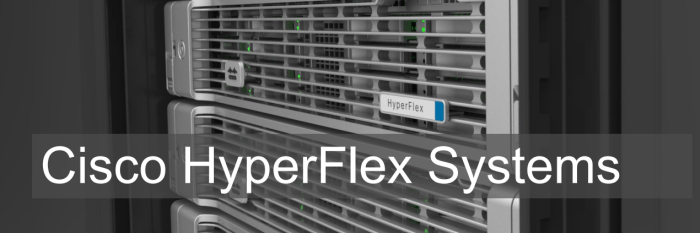
Cisco is unwrapping the covers on Hypeflex.   Their direct and targeted attack on the hyperconverged market.

The headlines are basically this….

  • A true hyperconvered system that includes network connectivity
  • Built on the tried and true UCS platform
  • A revolutionary storage system
  • No new administrative platform – a plug in with VCentre
  • Competitive with other offerings
  • Tested and proven today
  • Actually turns up in an hour.

What does it look like?

HyperFlexOSBlock

The story is much as you have seen in the past.   Server based platform, with on board disk.   However remember, hyperconvergence is about using “commodity” hardware with onboard DAS disk in order to deliver converged type infrastructure for lower cost with easy expand-ability.

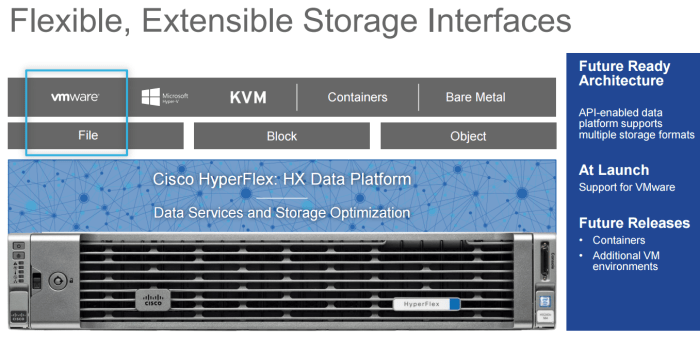
The system will launch with VMWare day 1, with other hypervisors and container support down the road.

The Secret Is In The Storage

The secret sauce with all hyperconverged solutions is in the storage layer, and Nutanix has always pried themselves on being the leader here, and they are, with developers from top tier companies they built a very mature product with demonstrated performance.    Many others have tried to meet or beat this performance and they continue to be the market leader – HyperFlex plans to challenge that.

HyperFlexCompress

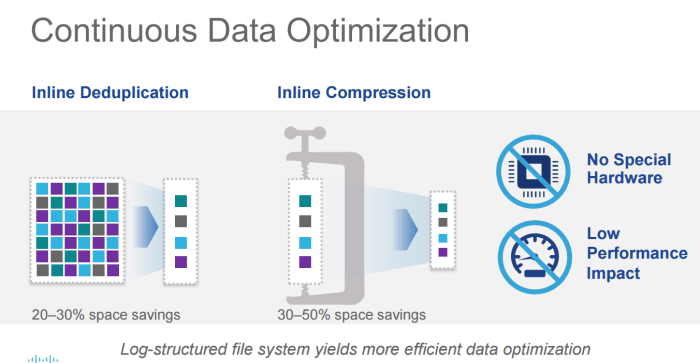
Cisco had to differentiate themselves.  By using a log based file system, with intelligent caching they have eliminated the 3-phase commit performance problems.   Basically with a 3 phase commit, we have to make sure that data is sent to all nodes before it’s committed as written.  Cisco eliminates that by log shipping and caching.    I am sure we will get more details as this moves on, and I will admit to not being a storage architect but the secret sauce is in the software.

De-duplication and Compression is all the rage, and they are delivering it here – with low performance impact.    The technical experts tell me – this is all around their caching technology.  Are you seeing a trend here?

What does this look like?

HyperFlexHardware

The Fabric Interconnect is right there on top – and HyperFlex is built on UCS – so the FI is how we control the hardware, manage nodes and provide the network.   HyperFlex will deliver where other hyperconverged companies have not – in the network.   While others tell customers “we use your network” – Cisco recognizes the important of engineering, and when building hyperconverged – the network is way too important to leave to the end users, the performance between nodes must be high, and predictable.   The UCS Fabric Interconnect is perfect for this task.  Why re-invent the wheel on connectivity, the FI delivers features and performance.

There will be a flexible deployment model  – list prices around $59K USD to start, which is competitive – and you can build with balanced, capacity heavy or compute heavy nodes, or a mixture to create your own custom environment.

HyperFlexAdmin

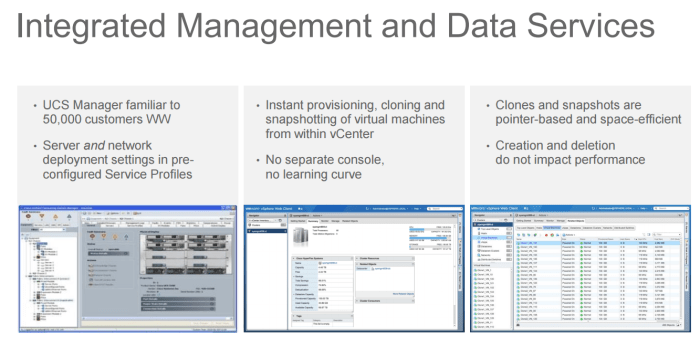
The administration is about familiarity here,  with the hardware being managed by the very familiar and manageable UCS Manager, and the hyperconverged part being managed with a plug in to VCentre.   No extra management portals or parts required.   This means time to value is fast, and time to market is also fast and chances are you will not any training to work on this thing.

HyperFlexPortfolio

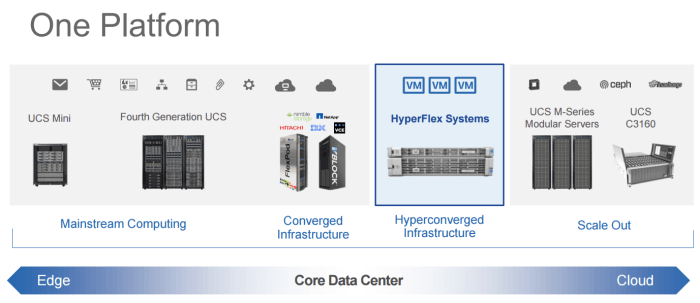
So where does this fit?   Well, it’s a whole new product line – but the pedigree of UCS is there, so the trusted and hardened UCS platform is right there – and it fits into the core data centre portfolio.

Independent Scaling

hyperflex1

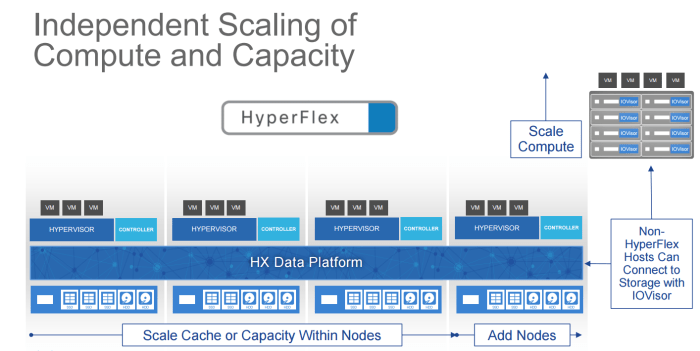
Expanding hyperconverged you need flexibility (HyperFlex?) and sometimes clients just want to add compute.   Luckily using IOVisor, you can actually access the storage from non HyperFlex hosts using their IOVisor software.    There is many instances when accessing this storage could be useful, call it migration or disaster recovery, or high availability.   For all the reasons we cannot think of this type of flexibility is great.

Each node has a “controller” which handles the local node, and mostly storage activities and manages the cache on that node.   Just like other platforms.

Failures

HyperFlexFail

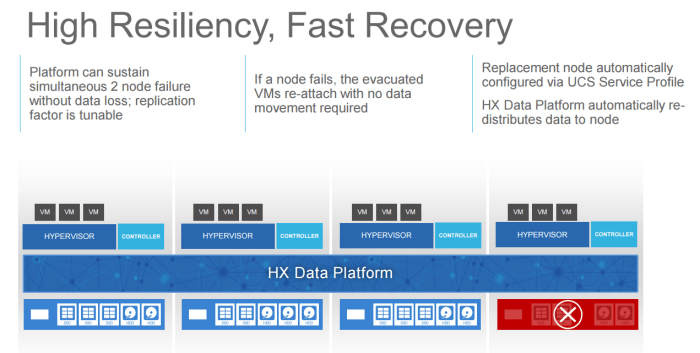
The system can handle two node failures, and because it’s built on service profiles, node replacement is obviously very easy.  As soon as the replacement node comes up, data replications begins immediately over the high performance built in network.

Where do you find out more?

http://www.cisco.com/go/hyperflex

That’s a wrap!    Looking forward to getting my hands on this thing,  if anyone was going to take a shot at this market – it’s Cisco and I cannot wait to get my hands on it.


Outlook 2016 Account Add Problem

Ran into a problem today adding an Exchange account to an Outlook 2016 installation

It seems Microsoft has removed most of the advanced settings as a result of the removal of MAPI support from Outlook, but what it means is that your Autodiscover – MUST work.

For lab environments, we don’t always setup Autodiscover, we just manually setup the accounts.    I figured I would add an SRV record to fix it, so I did.   However I had another problem.

Microsoft has a great tool called the Remote Connectivity Analyzer, which tests and tells you when it finds problems with connectivity – well – I passed most of them.  Yes there were a few errors, as AutoDiscover has a few methods.

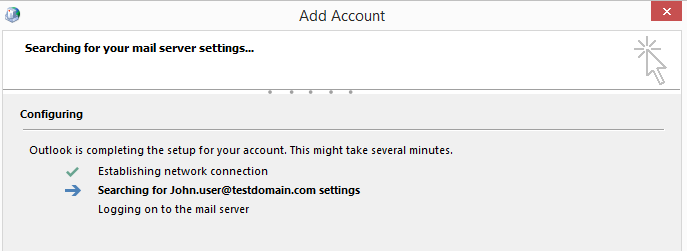
The mail settings panel would get “stuck” at this screen.   It would search forever.  Searching for your mail server settings stuck at searching for settings.

mailproblem

This is caused by the mail settings trying to auto discover using this URL

https://testdomain.com:443/Autodiscover/Autodiscover.xml

In my environment (and many others) this doesn’t exist.  We have a mail server running on mail.domain.com or owa.domain.com  – the root domain doesn’t have this.    However unless Mail settings get’s a 404, 500 or another HTTP error, it will try 20+ times to connect, each with a VERY long 30 second timeout.   – that means 15-20 minutes of trying before it will give up.    Much longer than any users (And me in particular) is ever willing to wait.

Solution?    Registry edit.

[HKEY_CURRENT_USER\software\policies\microsoft\office\16.0\outlook\autodiscover] “excludehttpsrootdomain”=dword:00000001

That’s it,  it tells Outlook to skip that step, and move on to other AutoDiscover methods.

A simple solution, which google didn’t immediately find me, I did find it buried in a few conversations on Reddit – but hopefully this post, will give it better goggleability.

Hopefully AutoDiscover Outlook 2016 and future versions will be come a little less problematic, a little less trouble, and not as slow.


Making your case for Cisco Live!

There is any number of blog entries about why you should go to Cisco Live!,  and while some are even lucky enough to hit up more than one event per year.

(Sidebar: I really want to try out Cisco Live Europe, I mean Berlin, really, but could they move it a few months later so that I can take a side trip to the Nurburgring on the way back?)

Here are a few online resources to help you justify your trip.

Cisco Live – Why Attend?

Cisco Live – Featured Blogs

So there are a few other opinions, here is mine.

Let’s talk about the reasons you will get some resistance.

  1.  A week away from the office, if your are in professional services, that is lost work time
  2. Cost – This is a complicated issue, especially when the company may not be able to send multiple resources.

Live vs Traditional Training

Traditional full training sessions tend to be 2-3 days of things we already know, and 2 days of real meat, with lunch and review crammed in there – so it is probably 1 maybe 2 days of really good stuff.     Assuming you do not have to travel for those (which many do) you would still have a loss of work time for sure, but you are not getting 5 days of benefit out of that session.

Many of us pick up new information via technical briefings.    Unfortunately those sessions are built for a wide audience, and tend to be “Powerpoint Hell” – not interactive, and sometimes remote.    That 3-6 hour session you were in – had what?  2-3 slides of good information?    These sessions just don’t have enough time to hit a real topic.   Take a briefing on a new router, let’s say the ISR series.   It would take literally days to explain in any reasonable detail everything that thing will do, you need multiple sessions even if it were possible.     What if you were voice focused?   Routing Focused?   This is where Live steps in.

Cisco Live – Immersive Efficient Learning

That’s the message I want to get across here.   It’s immersive, they cut through the junk and get right to the point.      The sessions are targeted at a particular audience.

So you want to talk sessions on ISR?

Advanved Troubleshooting on ISR, Converged Branch on ISR, QOS Migration on ISR, ISR architecture overview, iWAN on ISR 4000

Sure, you can hit up that archtiecture overview if you want — or simply read up on that ahead of time and then hit up the “Advnaced Troubleshooting” session and get some real meat.  That session would be 1 Hour and 48 minutes.   This isn’t being delivered by a sales guy either – these are high end TAC engineers – that you can ask questions!

8 solid hours of sessions at least – per day, that’s 2 hours,  so you have 3 other sessions. See where I am going?

The right speakers

We have all had our Cisco account managers or Technical Marketing Engineers deliver training or PowerPoint sessions – but really they are not the experts in the field.

You get amazing speakers like

Samer Theodossy – Sr Technical Leader of the Catalyst team

Denise Fishburne – CPOC Engineer and Lab Rat

Robert Barton – SE – Wireless

These are people that really know their stuff, and you can ask them questions!

World of Solutions

I call it “The Floor” – but what I really call it, is the ability to talk to everyone – because any vendor who is anyone is at Cisco Live, and they bring the best people.   Solarwinds,  IPSwitch,  Plantronics,  Splunk, HP, Intel, NetApp, EMC – you name it.    Take advantage and talk with them about your ideas, they bring high end brains to this event – grab one and talk.

Not to mention, Cisco has their own section demoing pretty much every single product, with product designers ready to answer questions.

Get Answers

I always have ideas, problems and things burning in the back of my head.   This is the place to get it handled.     Here’s a list of the ways you can collaborate and learn.

You can hit up a tech session and talk to the presenter after

Table Topics:   Sit down with other people – just like you – who have experience in a topic and “Talk shop” over lunch.

Meet The Expert:  Sign up for this!   Validate an idea, work on a design or talk troubleshooting and strategy with REAL Experts.   If you head in, and you need an extra expert – they will get you more.   You simply CANNOT get access to this outside of Live.

The Cost Battle – The 1/20th Argument

How do you justify the cost, let’s get down to it.

Flights: For those of us who have to travel from Canada, or a far away location, we are looking at significant travel costs – but when you consider we can have 20+ training sessions for the price of a single airline ticket – with quality presenters.   That’s a better deal.

Lodging:  The 20 for the price of 1 argument still works on this one.

Food:   No problem, the event has you pretty much covered on this one.

Event Cost:   You have options here, don’t wait till the last minute!

Pre-Reg closes March 14, and the price goes up by $300, so don’t wait.

Use Cisco Learning Credits if you have access to them, if you don’t – and you purchase Cisco – you need to call your account team right now and make sure you are maximizing your Cisco Learning Credit eligibility on purchases from Cisco.   25 CLC’s get’s you a full conference pass.

Talk to your partners, some will help you out here.

Do the math –  1/20th means that you can get into Live for $2000 or $200 per session if you do the math that way, and it doesn’t even factor in all the other learning.     Cisco Live costs about 1/2 or the same as some training sessions that deliver literally 1/20th the value.

Last Ditch Effort:  Explorer plus 365.   Ok so it’s not the best, and you miss out on technical sessions and the CAE,  but you are there, you get to see the World of Solutions, and have acces sto DevNET and Innovations talks and Keynotes.   This is worth it if it’s your only option or paying out of pocket.

Conclusions

Cisco Live is about VALUE FOR MONEY – You are away for a single week instead of multiple days that are broken up across the year, you get very high learning value per dollar and you are IMMERSED in it, which has been proven to cause better retention.

The networking capabilities with other professionals and Cisco engineers is something you simply cannot get anywhere else.

What are you waiting for?  Go book a meeting with your management and make your case!

See you in Vegas!


Meraki Launches Wave 2 AP

Cisco launched their merchant based 1830/1850 series Wave 2 AP’s with integrated controller, and we did get our hands on one – but have not done a full review yet.

Meraki has now hit the street with the M42,  a full on AC Wave 2 AP 3×3:3 with support for MU-MIMO – or Multi User MIMO.

mr42_front-top_transparent-450x150 (1)

The new Bluetooth Low Energy and Beacon technology is in there as well – also a feature not commonly used yet.    If you are still running on older Meraki gear without the dedicated security and RF optimization radio, this does have that and it will give you better security performance.   Plus you can do cool real-time spectrum analysis from your couch.

rf-optimization.jpg

It’s worth mentioning – investment in MU-MIMO technology for AP’s might be a little early, as MU-MIMO 100% requires client side support in order for it to function.    Right now nobody is selling Laptops, Phones, or anything with 802.11 AC Wave 2 support – and it’s not something you can just upgrade.

You can still get the 802.11AC MIMO benefits on your existing AC clients — of which there are very few,  most new Apple products support AC, but smaller products are generally 1 stream anyway, so it doesn’t make a big difference.    The big deal here is once we have 1 stream Wave 2 clients, we can use multi streams for more clients instead of more speed.  Which for multi user environments is more important.

Wave 2 – doesn’t help you right now – at all – so jumping on the Wave 2 bandwagon on your AP’s will give you great bragging rights but no more performance.


Perce Neige 2016 and 2015 CRC Wrap

It’s a wrap on the 2015 season, and while I didn’t post something, this week is the Canadian International Auto Show and our own Antoine L’Estage and Subaru Rally Team Canada have their car on display – beautiful.    Hard to think the car was beat up with a destroyed bumper only 4 days before at Perce Neige.

12715679_10153243962941331_4305204152733905186_n

Here’s a great video showing their 2015 season.   Alan Ockwell is taking a year off from co-driving with Antoine so we will see how things go in 2016.


A quick highlight of the Perce Neige 2016 event held in Maniwaki Quebec.   I was again there this year with the Rally Sweep Ontario team providing recovery for the crews.  This year we had 2 teams, and 4 trucks the same as last year and covered all of the stages.  Our team worked from early in the morning until close to 11pm with only 30 minutes for lunch time.

Peter MacDonald a man who has spent his life behind the Camera  is now driving a car in the Ontario Provincial Rally Championship this year.  This is what he had to say in our exclusive interview at Perce Neige after his first stage.


It wasn’t all great, with a field full of challenges,  Jeremy Norris had a bad off, he was checked out at local hospital, but is ok.

Can-Jam Motorsports was unveiling a new car finished only a few days before the event with Beland at the wheel.  They didn’t finish, but the car given a good shakedown.   A very touching memorial to the loss of Mac and Blake two very important team members in the Can-Jam Family.

12512554_10153202795207003_5435294327114424869_n

We were right there after Antoine L’Estage and Subaru Rally Team Canada went off in the finish area of Stage 2,  they arrived at Stage 3 and rushed to get the car repaired enough to continue.


In an unfortunate turn of events the Subaru team had a failure of an “External Accessory” and had to retire.   Seen here the team was adding over 2+ Litres of oil to the engine, our sources tell us they drove this short 8KM stage, and then added 2+ more before going to service.


In the end, we had an amazing time, and we were busy, recovering one car a record 5 times, but it is all in a days work and that is why we love rally!


Cisco iWAN with Drag and Drop on APIC-EM?

Ever since Meraki announced iWAN support – I have been thinking “Hmm, if Meraki does iWAN as easy as they do everything else, that’s one hell of a compelling story”

When I speak to collegues who have done iWAN on Cisco ISR platforms – it is

iWAN is still something many have not played with – but the value prop is pretty simple right?    It boils down to two simple concepts

  1.  I can use my internet to transport some of my WAN traffic
  2.  I can lower costs by using smaller MPLS circuits because I can use my cheap internet pipe for that.

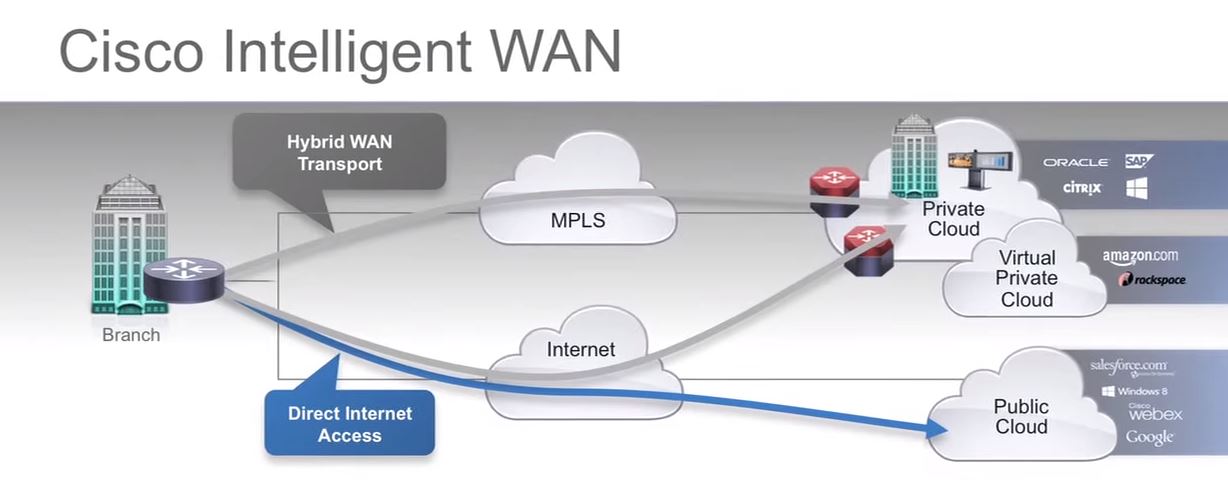
So really we are moving away from passive/active world of MPLS + Internet, and VPN over internet if MPLS fails.   Everything is active/active, but unlike traditional load sharing type arrangements, we make intelligent decisions of what traffic goes where and when.

So the iWAN concept looks like this….

APICEM3

Sounds like marketing right?  Well, it is a little bit.   It’s really a concept based on a bunch of ideas.

Transport Independence – We can send the data on any link we have to get to the other side, that uses DMVPN

Application Optimization – That’s QOS and AVC

Intelligent Path Control – The ability to control what flows over what path and when – That’s PFR

Put all that together, and you get iWAN.    Keep in mind your endpoints might also be running ZBFW, Voice or other applications that will make this difficult.

It’s Hard

I’m sure some will disagree with me — but iWAN is difficult.  Not in a lab, in real world, it is alot to configure.  Here is one document — on just the PFR part of iWAN..  http://docwiki.cisco.com/wiki/PfR3:Solutions:IWAN 

So the concept is good, and sound but in practice, it requires a lot of skill to deploy, and to maintain the same skills are continually needed.

This is why many customers have not looked at it yet, if they have the skills in house, with time to burn – then perhaps, but to bring in someone from outside, is costly.   As someone who is constantly working with clients to reduce cost and deliver value, it’s hard to say “Yes go spend $50,000 deploying iWAN to save yourself $1000 a month” — the math doesn’t work.

APIC-EM Managing iWAN

The APIC-EM is an ever evolving product but it quickling becoming the bespoke “software defined” network platform for edge, WAN and access.   The benefits including path visualization, and application control are very cool and provide us with visibility like we have never had before.

Ok don’t get me wrong here,  yes this is a GUI, and I am a hard core CLI guy, from the early telecom days and 3 letter mnemonics I love my CLI’s but there simply isn’t a way to visualize 10 pages of policies without a GUI, or I suppose if I was 20 again and had that level of brain power – but it simply isn’t there for me.

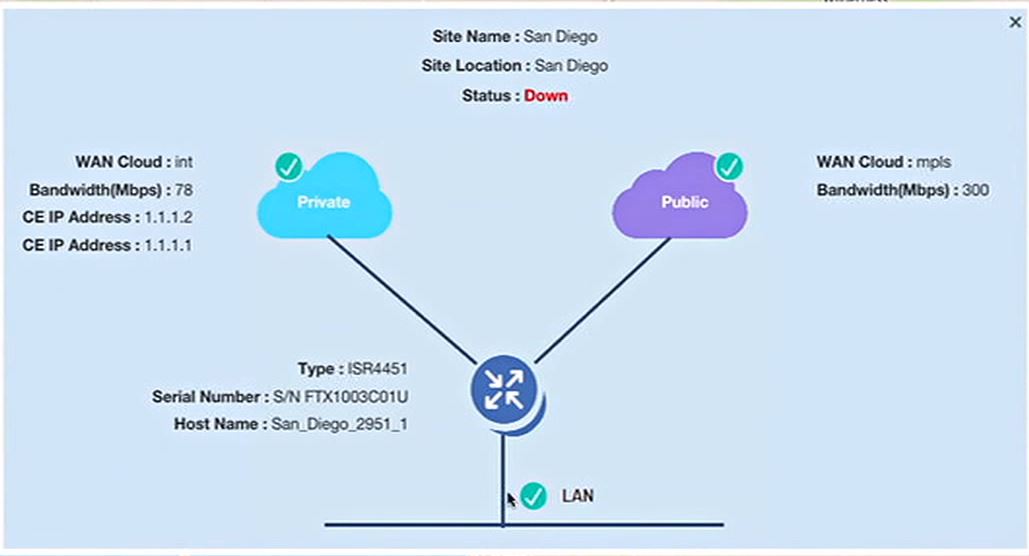
First we can see very clearly the status, and configuration of what our iWAN network looks like, including health, and a quick review of what is set up where and how, nice pictures, make things easier.

apicem2

The APIC-EM gives us the ability to build, in a GUI the network policies that meet our business needs for our WAN.  This means that people who are not network savvy, application owners can now understand and make intelligence decisions based on provided information .   Where do we learn about the network?   APIC-EM uses the NBAR data to find out what applications are running, and those that are not, we can define.  1200 Applications are in there by default.

Once defined, we can drag/drop/GUI Design what fits where, and over what link we want to use, either Internet, MPLS, or even balanced over both.  All with full fail over, and remember we have not touched a CLI yet!

APICEM1

APIC manages all your certs, configures the DMVPN, handles IOS version deployment and takes care of endpoints.   I make these statements from what I am told — is it really this easy?  Well, that is a good question.  I am working with the @ciscoDCloud team to see if we can get a real demo of it up to try out.

That Easy?

So that’s the question, iWAN was marketed well, but the costs / time and difficulty wasn’t really well explained until you get down into it.    Is this going to make it easier?  It sure looks like it.     I just need to get my hands on it to find out – is it that simple?

When I find out – I will let you all know.

Media

TechWise TV with @robbboyd has a good overview